
Transporting heavy materials up steep inclines is one of the most physically demanding and hazardous tasks in construction and landscaping. As the industry moves towards mechanization to improve safety and efficiency, the Electric Barrow has emerged as a vital tool. However, unlike operating on a flat concrete surface, navigating a 30-degree slope introduces complex physics involving gravity, traction, and center of gravity dynamics. Understanding the true safe carrying capacity of an electric barrow under these extreme conditions is not just about motor power; it is about the interplay of structural integrity, braking systems, and surface friction.
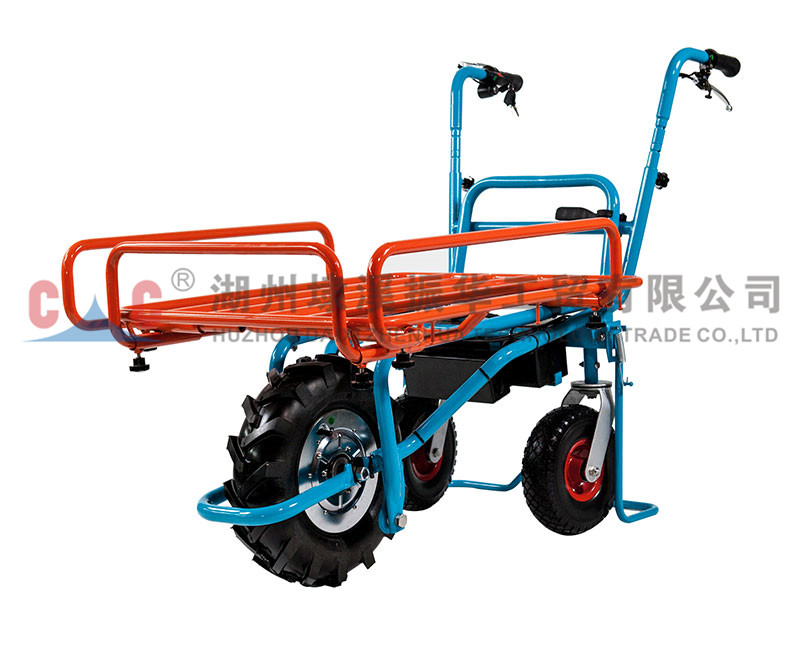
When specifying a Heavy Duty Power Barrow for Construction Sites, engineers must apply a significant "deration factor" to the stated maximum capacity when operating on a 30-degree incline. While a flat-ground capacity might be 300kg, the safe load on a slope can be effectively halved. This is because as the incline increases, the component of the gravitational force acting perpendicular to the slope (stabilizing the load) decreases, while the parallel component (pulling the unit backward) increases. If the center of gravity shifts beyond the rear axle's tipping point during ascent, the unit risks flipping backward. Furthermore, on a descent, the gravitational pull significantly increases the braking torque required to stop the load safely, meaning the braking system often becomes the limiting factor before the motor's torque does.
Evaluating the performance of a heavy-duty unit on a slope versus flat ground highlights the necessity of conservative load management.
| Performance Factor | Flat Ground Operation | 30-Degree Slope Operation |
| Effective Load Capacity | 100% of Rated Capacity (e.g., 300kg). | Approximately 50-60% of Rated Capacity (e.g., 150-180kg). |
| Center of Gravity Stability | Stable; tipping risk is minimal. | Critical; high risk of tipping backward if load is top-heavy. |
| Braking Distance | Short; requires minimal braking force. | Extended; requires significant braking torque to prevent runaways. |
Calculating load capacity is futile if the machine cannot gain traction to move the load. On a 30-degree slope, the friction coefficient between the tire and the ground is pushed to its limit. A 4x4 Electric Wheelbarrow All Terrain system provides a distinct advantage over standard 2x4 models by distributing torque to all four wheels. This prevents wheel spin, which not only halts progress but can also carve out ruts in soft soil, destabilizing the vehicle. All-terrain tread patterns with deep lugs are essential to "bite" into the surface, converting the motor's electrical power into upward motion rather than wasted kinetic energy.
The choice between drive systems and tire types determines whether the load moves or the machine slips.
| Feature | 2-Wheel Drive (Rear) | 4-Wheel Drive (All Terrain) |
| Traction on Loose Soil | Poor; rear wheels may dig in, losing forward momentum. | Excellent; distributed torque reduces slippage. |
| Weight Distribution | Load pushes down on drive wheels, but steering is light. | Maximum grip; however, requires more effort to turn on flat ground. |
| Slope Capability | Limited to approx. 15-20 degrees with heavy loads. | Capable of 25-30 degrees with safe load management. |
Just as Fengrun Rope Weaving Co., Ltd. emphasizes the critical importance of "Quality and Innovation" in our manufacturing processes to ensure safety and reliability in every product, the engineering behind a 4x4 electric barrow demands the same level of rigor. The transmission systems and chassis in these machines must withstand immense torsional forces, much like the high-tensile strength ropes and webbing we produce.
The Climbing Ability of Electric Barrows on Slopes is defined not just by the angle, but by the duration of the climb. Electric motors generate heat, and when pushing a heavy load up a 30-degree gradient, the motor operates at peak amperage. Prolonged ascent can trigger the thermal overload protection, causing the motor to cut out to prevent permanent damage. Therefore, "safe carrying capacity" also implies a capacity that allows the motor to operate within its thermal envelope for the duration of the specific job. Modern brushless motors have improved thermal efficiency, but operators must understand that continuous high-grade climbing requires intervals to cool down or a reduced load to maintain thermal equilibrium.
Thermal management strategies are essential for preserving motor life during steep ascent operations.
| Thermal Scenario | Overloaded Operation | Safe Operation |
| Motor Temperature | Rapidly exceeds thermal limits, triggering shutdowns. | Managed within optimal range via load reduction. |
| Component Wear | Accelerated degradation of brushes and windings. | Normal lifespan maintained. |
| Result | Mid-slope failure requiring manual intervention to rescue. | Consistent performance and reliable cycle completion. |
In the context of an Electric Wheelbarrow for Garden Landscaping, the terrain is often softer than construction sites. A 30-degree grassy slope presents a different challenge: the risk of sinking and sliding. Unlike hard-packed dirt, grass has a lower shear strength. Consequently, the safe carrying capacity must be further reduced to prevent the barrow from sliding down the hill or creating deep ruts that damage the landscaping. Operators in this sector often utilize wider, low-pressure "balloon" tires to increase the surface contact area (footprint), spreading the load and reducing ground pressure.
Terrain-specific adjustments are necessary to balance ground preservation with load capacity.
| Terrain Type | Hard Packed Dirt (Construction) | Grassy Slope (Landscaping) |
| Tire Selection | Knobby, high-pressure tires for grip on hard edges. | Wide, low-pressure tires to float and prevent sinking. |
| Safe Load Factor | Limited by tipping point and motor torque. | Limited primarily by ground shear strength (slipping). |
| Ground Impact | Minimal scarring. | High risk of turf damage if overloaded. |
According to the "2024 Equipment Trend Report" by the Association of Equipment Manufacturers (AEM), the adoption of battery-powered compact equipment is accelerating due to stricter emission regulations in urban and enclosed environments, emphasizing the need for high-torque electric drivetrains that can replace traditional combustion engines in heavy-duty applications.
Source: Association of Equipment Manufacturers (AEM)
The comparison of an Electric Powered Wheelbarrow vs Manual unit becomes starkly evident on a 30-degree slope. Manually pushing a heavy load up such an incline is biomechanically unsafe, placing extreme strain on the lumbar spine and cardiovascular system. It is often impossible to move loads over 100kg manually on this gradient without risking injury or loss of control. An electric barrow transforms this task from a safety hazard to a routine operation. While the initial investment is higher, the return on investment (ROI) is realized through reduced labor costs, fewer injuries, and the ability to move larger volumes of material per day.
Comparing the operational feasibility highlights the necessity of electrification for slope work.
| Consideration | Manual Wheelbarrow | Electric Powered Wheelbarrow |
| Safe Load on 30-Degree Slope | < 50kg (Extreme physical exertion). | 150-200kg (Depending on model). |
| Operator Fatigue | Very High; limits trips per day. | Low; limited by battery capacity, not physiology. |
| Safety Risk | High; risk of slipping and losing control of the load. | Moderate; manageable with proper training and braking. |
In conclusion, determining how much weight an Electric Barrow can safely carry on a 30-degree slope requires a holistic engineering approach. While the motor's power and the Heavy Duty Power Barrow for Construction Sites ratings provide a baseline, operators must strictly derate the load to account for gravity, braking limitations, and ground conditions. The utilization of a 4x4 Electric Wheelbarrow All Terrain system significantly enhances safety by maximizing traction. Whether for Electric Wheelbarrow for Garden Landscaping or heavy construction, adhering to the principles of physics over marketing hype is essential for safe and efficient operation. As highlighted by the Electric Powered Wheelbarrow vs Manual comparison, the electric solution is not merely a convenience but a safety imperative on steep gradients. we understand that whether it is the strength of a rope or the torque of a motor, quality specifications are the foundation of workplace safety.
Overloading on a steep slope can cause the motor to overheat and cut out, or worse, cause the machine to tip backward or lose braking control while descending, leading to potential injury or equipment damage.
While some high-end models can, most standard electric wheelbarrows struggle significantly beyond 15-20 degrees. A 30-degree climb typically requires a specialized 4x4 model and a reduced load.
A 4x4 system provides power to all wheels, significantly increasing traction (grip) on loose or slippery surfaces, which prevents the machine from sliding back or spinning out during ascent.
Higher wattage (e.g., 1000W+) generally provides higher torque, allowing the machine to maintain speed and control under the heavy gravitational load of a steep incline without overheating quickly.
Turning on a steep slope is dangerous and should be avoided if possible. It shifts the center of gravity sideways, increasing the risk of tipping over. It is best to drive straight up or down the slope.
Search
Search for products that you are interested in.
Company

 Privacy